The Life and Times of the Wicked Witch of the West.
You have read this one before. It was over a decade ago, before the musical hit Broadway, and you've wanted to reread it ever since. You borrowed the book the first time you read it though, so you've been searching for a inexpensive copy for years now. A few weeks ago, you found a pristine paperback edition for $1.50 and you were like, "I'll get you, my pretty!"
You're a nerd. You know that right?
Gregory Maguire specializes in novels that re-imagine familiar stories with new and interesting twists. He has taken on such classics as "Cinderella," "Snow White," and "A Christmas Carol". In "Wicked," he tackles the story of the Wizard of Oz (obviously) and it is the best work of his career. It is never clear whether Maguire draws more from L. Frank Baum's book or from the 1939 movie, but what is clear is that this is more than a story about a familiar character. "Wicked" is an examination of the nature of evil itself. It is an attempt to see a familiar character, one who is automatically thought of as evil (Wicked is right there in her name), from a different point of view.
One of the great sages of your life, Obi Wan Kenobi, is quoted as telling Luke Skywalker in Return of the Jedi that "you're going to find that many of the truths we cling to depend greatly on our own point of view." As you have gotten older, and tried to see things from different perspectives, this quote keeps becoming more and more true. Heroes and villains are often easily interchangeable depending on the point of view. Nelson Mandela is now seen as a hero and the father of modern South Africa, but he was seen as a terrorist for decades before. Martin Luther King Jr. is such a hero to you that you have raised your boys with his speeches ringing in their ears, and his words guiding their beliefs, but from a different point of view, Doctor King was a dangerous revolutionary who was bent on the destruction of an entire society's way of life. The same can be said of Vaclav Havel, Caesar Chavez, Ho Chi Minh, or even Jesus of Nazareth.
So it is with Elphaba. Maguire created her name as an homage to the author of Oz's initials, L. F. B... "El-Pha-Bah." Elphie to her friends. Fabala to her devout father. The Wicked Witch of the West to generations of American children who grew up not caring if she had a back story, only fearing her for her skin color and her hatred of a girl named Dorothy and her little dog too. But Maguire fleshes out the witch's personality in ways that lend her a familiarity beyond your childhood fear. In fact, you quickly came to love Elphaba.
One of the most interesting things about the book is how Maguire tells most of it, not from the witch's perspective, but mostly from the perspective of her friends and loved ones. First, through the eyes of her lonely and promiscuous mother, her long suffering Nanny, and her religiously zealous father. Then from the perspective of her college roommate Glinda, who is revealed to be more of a self serving, servile, class conscious bitch than any kind of good witch. Next you see Elphaba from the perspective of another classmate, the stalwart and clear headed Munchkin boy, Boq. But it is when Fiyero, a dark hued pagan prince from the West, and Elphaba begin their love affair a few years after college that we see Elphaba as a lithe, sexual, passionate person.
She is bold, curious, skeptical, and iconoclastic. She has a depth of
compassion for those of the social classes most often pushed aside. She
is politically passionate, dropping out of school to become a
revolutionary. She is misunderstood and she is prejudged. Elphaba's only
desire after the heartbreak of her life is to go forth and do no harm
in the world. The Wicked Witch. Do no harm. But you wouldn't know it from the way others think of her.
Indeed, it is a full 200 pages before the voice of the novel comes from Elphaba herself, until Maguire allows us to hear her thoughts in her own head, not spoken out loud to another character. She is almost always presented from other people's perspectives.
And that is what the book is about. What we call evil is only that from a certain perspective. Good witches and bad witches. Good Guys versus Bad Guys. Us versus Them.
But the truth is that there never really is a Them. There is only Us.
True evil, not the stuff of children's stories, but true evil begins when one of us allows ourselves to begin thinking of some of the rest of us as enemies. Maybe evil is not just the violence and suffering we inflict on one another. Maybe the greatest evil of all is when we choose to stop caring for others, even if those others are a Them. Only then are we able to allow ourselves to excuse all kinds of savagery being inflicted on others. Only once we think of them as just that. Others. Them.
"Wicked" uses one of the most iconic cultural images of evil and shows that it may not be that at all. Elphaba isn't one of Them. She is Us. And if the Wicked Witch of the West can be shown to be one of Us, who else could be too? Who else do you consider evil only because you have been told to? How many other times do you assume someone just IS the way they are without considering their history, without putting their lives in perspective?
For years now this book has helped you try to be aware of not making that mistake. It has helped you to consider things from the perspective of the Other. That's pretty powerful. Maybe that's why you've been looking to get your hands on another copy for over a decade now.
Maybe that's why you are always looking for new great books too. Because they can affect you so powerfully.
On to the next book!
Sunday, May 26, 2013
Monday, May 13, 2013
"The Devil in the White City" by Erik Larson (2003)
America's first serial killer on the loose during the Chicago World's Fair. This should be interesting.
Your first book review on this blog was of Erik Larson's "In The Garden of Beasts." The only reason you even read that book was because you had heard of Larson through everyone talking about how good "The Devil in the White City" was. So this review feels like you are coming back full circle to the beginning of the blog.
As with the last Larson book, the multiple pages of praise at the beginning were a bit of a turn off, as was Larson's fleeting, almost offensively casual relationships with maps. He gives you two maps but neither are of any actual help when it comes to locating any of the action in the book. Honestly, why would anyone even include them if they don't do any good? It's just infuriating to those of us who have unhealthy obsessions with maps. So, in all honesty, you found the parts of the book before it even started a bit frustrating.
After that (as in, once you started actually reading the book) it got much better. Larson is one hell of a story teller. He starts building tension from the very beginning, peppering his prose with copious foreshadowing and insinuation, hinting at plot lines that promise to reveal themselves in the next few hundred pages. Well crafted tension like that always encourages you to speed through any book. It's why Dan Brown novels are so easy to read.
The story of "The Devil in the White City" promises on the cover to be about one of America's first serial killers, but there are really two almost unrelated plot lines. One certainly follows the murderer, H. H. Holmes, as he ensnares and kills dozens of women and children, but the other plot line follows the preparation for, and the construction and running of the 1893 Chicago World's Fair, and has almost nothing to do with Holmes. The Fair, officially called The World's Columbian Exhibition, was set to commemorate the 400 year anniversary of Columbus's discovery of the New World. In actuality, it was an attempt to show up the French who had just concluded their record-breaking (and Eiffel Tower erecting) World's Fair in 1889. The architects, artists, and entrepreneurs of the United States were eager to show the world that they could out shine the spectacles of Paris. This was all about honor and pride.
"The Devil in the White City" is an enchanting (if at times disturbing) snapshot of what life was like as America became the modern nation you think of it as being today. Much of what you think of as being integral to your concept of America began there at the Chicago World's Fair, and yet it was happening only 100 years before you were attending high school.
The more history you read and the more you internalize the timeline of world events, the more you realize how very young the United States really is.
You've never been much for the True Crime section of the book store, so the parts of "The Devil in the White City" chronicling the serial killer and his sins weren't nearly as satisfying to you as the historical perspective of Chicago's coming of age party at the tail end of the Gilded Age. It was a time between two terrible wars, the Civil War had been over for thirty years, and the First World War wouldn't be fought for another twenty. Men who faced Pickett's charge at Gettysburg also watched the buildings of the Fair rise from the banks of Lake Michigan, and it is possible that many of those same men would also live to see some of the world's first airplanes riding the wind in the first decade of the next century. It was a time of huge changes and growing pains for a nation which was just beginning to feel the responsibilities of a major world power.
Many of those huge changes and novelties presented at the Fair became permanent fixtures of American life. The Chicago World's Fair was where incandescent light bulbs finally grabbed hold of the population and became a mainstay of modern life. Elias Disney was one of the workers who helped construct the jaw-dropingly beautiful, self-contained city nestled inside a major metropolitan area. His son Walt paid close attention. The Pledge of Allegiance was created to celebrate the day the fair was dedicated. Children throughout the U.S. recited it that day (without mention of God or even the United States of America) and they have been ever since. L. Frank Baum walked among the gigantic buildings whose beauty earned the Fair the nickname The White City. He was bewitched by the sights, and soon went home and wrote a book about an Emerald City and a yellow brick road. Buffalo Bill and Annie Oakley rode every night of the Fair and Thomas Edison even recorded Mrs. Oakley's prowess with a rifle on his new video camera (footage here). The negotiations between Daniel Burnham (the architect who was in charge of the Fair's construction) and striking carpenters and other workers who were building the Fair's White City lead to major concessions by the Fair's management. The workers were given minimum living wages and overtime pay. This showed the United States how effective organized labor could be and it served as a major catalyst to America's Labor Unions at the dawn of the 20th Century.
On October 9th, 1893, "Chicago Day," no fewer than 750,000 people attended the events at the Fair. No single event in the peacetime history of the world had ever had so many people attending it at one time. So many people attended the Fair over the six months period it was open that it is hard to overstate its influence on American culture. Men like Houdini, Tesla, and Darrow wandered along the Fair's Grounds, drinking in the spectacle. Teddy Roosevelt was there, and Woodrow Wilson. Susan B. Anthony and Helen Keller were drawn to the event as well. The world's first Ferris Wheel gave 2,000 people at a time a bird's eye view of the park grounds and Lake Michigan. It was a heady, joyful time and it inspired generations of American's to go on and shape the world around them in ways that you still feel today.
But there was darkness too. There were snowstorms that delayed construction and there were wind storms that collapsed buildings and terrified everyone. There were fatal accidents and there were fires.
And there was murder.
H. H. Holmes was a physician who had built a three story building near the fair grounds. He used it as a hotel during the Fair and he lured women into this house of horrors. And then he killed them. Holmes was a true psychopath, showing no remorse or sympathy for his victims. In fact, on more than one occasion, if his targets had children, he simply killed the children as well. But he wasn't a Jack the Ripper type, grabbing strange women and eviscerating them in the darkness. No, Holmes lured his prey into his arms. The thrill of being in absolute control was his motivation. He was manipulative and disarmingly charming and he used these talents to build relationships with his victims, even going so far as to marry some of them before suffocating them with gas or chloroform. Holmes then cremated the bodies of his victims in his custom built kiln in the basement of his World's Fair Hotel.
Psychopaths are not born evil, but they are also not simply conditioned to become evil either. It seems that producing a serial killer requires a combination of both nature and nurture. The World's Fair wasn't what caused Holmes to become a killer, that tendency was already in his character, but the huge influx of unsuspecting women into his city sure didn't discourage his predatory nature.
As you neared the end of "The Devil in the White City" you were sure there was some metaphor waiting to be teased out from the juxtaposition of these two stories; something about how even as a nation step onto the world's stage and into the light of true modernity, there are also some corners of darkness that remain; or about how no matter how good we think were are, as individuals or as nations, there always remains some violent fragment of ourselves lying inside of us just waiting for an opportunity to lash out... or something like that.
But mostly you were simply impressed by Larson's ability to add excitement and dramatic flair to a book that could have easily become a boring litany of disconnected events, and you were impressed by his talent for making history come alive, to read more like a novel than nonfiction. Some authors can take a good story and ruin it. But it takes impressive talent to take many, unconnected stories and find the narrative thread that connects them all together. The best historians are really just the best story tellers.
Isn't that why you read books anyway? For the great stories?
On to the next book!
P.S. While you were reading this book, there was an interview on Fresh Air with Adrian Raine, author of "The Anatomy of Violence," a book about the biology of psychopathology and certain people's tendency towards violence. Fascinating stuff. Maybe this should be added to your list of books to read next.
Your first book review on this blog was of Erik Larson's "In The Garden of Beasts." The only reason you even read that book was because you had heard of Larson through everyone talking about how good "The Devil in the White City" was. So this review feels like you are coming back full circle to the beginning of the blog.
As with the last Larson book, the multiple pages of praise at the beginning were a bit of a turn off, as was Larson's fleeting, almost offensively casual relationships with maps. He gives you two maps but neither are of any actual help when it comes to locating any of the action in the book. Honestly, why would anyone even include them if they don't do any good? It's just infuriating to those of us who have unhealthy obsessions with maps. So, in all honesty, you found the parts of the book before it even started a bit frustrating.
After that (as in, once you started actually reading the book) it got much better. Larson is one hell of a story teller. He starts building tension from the very beginning, peppering his prose with copious foreshadowing and insinuation, hinting at plot lines that promise to reveal themselves in the next few hundred pages. Well crafted tension like that always encourages you to speed through any book. It's why Dan Brown novels are so easy to read.
The story of "The Devil in the White City" promises on the cover to be about one of America's first serial killers, but there are really two almost unrelated plot lines. One certainly follows the murderer, H. H. Holmes, as he ensnares and kills dozens of women and children, but the other plot line follows the preparation for, and the construction and running of the 1893 Chicago World's Fair, and has almost nothing to do with Holmes. The Fair, officially called The World's Columbian Exhibition, was set to commemorate the 400 year anniversary of Columbus's discovery of the New World. In actuality, it was an attempt to show up the French who had just concluded their record-breaking (and Eiffel Tower erecting) World's Fair in 1889. The architects, artists, and entrepreneurs of the United States were eager to show the world that they could out shine the spectacles of Paris. This was all about honor and pride.
"The Devil in the White City" is an enchanting (if at times disturbing) snapshot of what life was like as America became the modern nation you think of it as being today. Much of what you think of as being integral to your concept of America began there at the Chicago World's Fair, and yet it was happening only 100 years before you were attending high school.
The more history you read and the more you internalize the timeline of world events, the more you realize how very young the United States really is.
You've never been much for the True Crime section of the book store, so the parts of "The Devil in the White City" chronicling the serial killer and his sins weren't nearly as satisfying to you as the historical perspective of Chicago's coming of age party at the tail end of the Gilded Age. It was a time between two terrible wars, the Civil War had been over for thirty years, and the First World War wouldn't be fought for another twenty. Men who faced Pickett's charge at Gettysburg also watched the buildings of the Fair rise from the banks of Lake Michigan, and it is possible that many of those same men would also live to see some of the world's first airplanes riding the wind in the first decade of the next century. It was a time of huge changes and growing pains for a nation which was just beginning to feel the responsibilities of a major world power.
Many of those huge changes and novelties presented at the Fair became permanent fixtures of American life. The Chicago World's Fair was where incandescent light bulbs finally grabbed hold of the population and became a mainstay of modern life. Elias Disney was one of the workers who helped construct the jaw-dropingly beautiful, self-contained city nestled inside a major metropolitan area. His son Walt paid close attention. The Pledge of Allegiance was created to celebrate the day the fair was dedicated. Children throughout the U.S. recited it that day (without mention of God or even the United States of America) and they have been ever since. L. Frank Baum walked among the gigantic buildings whose beauty earned the Fair the nickname The White City. He was bewitched by the sights, and soon went home and wrote a book about an Emerald City and a yellow brick road. Buffalo Bill and Annie Oakley rode every night of the Fair and Thomas Edison even recorded Mrs. Oakley's prowess with a rifle on his new video camera (footage here). The negotiations between Daniel Burnham (the architect who was in charge of the Fair's construction) and striking carpenters and other workers who were building the Fair's White City lead to major concessions by the Fair's management. The workers were given minimum living wages and overtime pay. This showed the United States how effective organized labor could be and it served as a major catalyst to America's Labor Unions at the dawn of the 20th Century.
On October 9th, 1893, "Chicago Day," no fewer than 750,000 people attended the events at the Fair. No single event in the peacetime history of the world had ever had so many people attending it at one time. So many people attended the Fair over the six months period it was open that it is hard to overstate its influence on American culture. Men like Houdini, Tesla, and Darrow wandered along the Fair's Grounds, drinking in the spectacle. Teddy Roosevelt was there, and Woodrow Wilson. Susan B. Anthony and Helen Keller were drawn to the event as well. The world's first Ferris Wheel gave 2,000 people at a time a bird's eye view of the park grounds and Lake Michigan. It was a heady, joyful time and it inspired generations of American's to go on and shape the world around them in ways that you still feel today.
But there was darkness too. There were snowstorms that delayed construction and there were wind storms that collapsed buildings and terrified everyone. There were fatal accidents and there were fires.
And there was murder.
H. H. Holmes was a physician who had built a three story building near the fair grounds. He used it as a hotel during the Fair and he lured women into this house of horrors. And then he killed them. Holmes was a true psychopath, showing no remorse or sympathy for his victims. In fact, on more than one occasion, if his targets had children, he simply killed the children as well. But he wasn't a Jack the Ripper type, grabbing strange women and eviscerating them in the darkness. No, Holmes lured his prey into his arms. The thrill of being in absolute control was his motivation. He was manipulative and disarmingly charming and he used these talents to build relationships with his victims, even going so far as to marry some of them before suffocating them with gas or chloroform. Holmes then cremated the bodies of his victims in his custom built kiln in the basement of his World's Fair Hotel.
Psychopaths are not born evil, but they are also not simply conditioned to become evil either. It seems that producing a serial killer requires a combination of both nature and nurture. The World's Fair wasn't what caused Holmes to become a killer, that tendency was already in his character, but the huge influx of unsuspecting women into his city sure didn't discourage his predatory nature.
As you neared the end of "The Devil in the White City" you were sure there was some metaphor waiting to be teased out from the juxtaposition of these two stories; something about how even as a nation step onto the world's stage and into the light of true modernity, there are also some corners of darkness that remain; or about how no matter how good we think were are, as individuals or as nations, there always remains some violent fragment of ourselves lying inside of us just waiting for an opportunity to lash out... or something like that.
But mostly you were simply impressed by Larson's ability to add excitement and dramatic flair to a book that could have easily become a boring litany of disconnected events, and you were impressed by his talent for making history come alive, to read more like a novel than nonfiction. Some authors can take a good story and ruin it. But it takes impressive talent to take many, unconnected stories and find the narrative thread that connects them all together. The best historians are really just the best story tellers.
Isn't that why you read books anyway? For the great stories?
On to the next book!
P.S. While you were reading this book, there was an interview on Fresh Air with Adrian Raine, author of "The Anatomy of Violence," a book about the biology of psychopathology and certain people's tendency towards violence. Fascinating stuff. Maybe this should be added to your list of books to read next.
Monday, April 29, 2013
"Endurance" by Alfred Lansing (1959)
Two castaway books in a row. Is this a theme? What's next, "The Odyssey?" Actually, when it comes to cursed voyages, Odysseus has got nothing on Shackleton. This story is almost as unbelievable.
It all started with this google maps site here. You found it on some random site and shared it with your cousin, Eric, knowing it was right up his alley. He was very excited by it. Eric reminded you that Ernest Shackleton was one of his heroes. "Really?" you asked, admitting that you knew very little about the man. "Is there a good book I can read to learn more about this guy?" Eric didn't even hesitate. "Yep. 'Endurance' by Alfred Lansing," he said, and you were reading it within a few weeks.
The website above is almost an allegory for Shaclekton's life. He was an Irish explorer who was driven to accomplish great things, but he was repeatedly frustrated in his efforts. The hut featured in the website was Shackleton's home base for an expedition that almost reached the South Pole. In January of 1909, his team made it to within 97 miles of their goal before being forced to turn back (Shackleton was knighted for this impressive attempt). But he fared better than his friend Robert Falcon Scott, who died with his entire team in 1912 after reaching the South Pole, only after finding that a Norwegian team, lead by Roald Amundsen, had beaten them by just 33 days. What a hell of a reason to die! The American, Robert Peary, claimed to have also reached the South Pole even before the Norwegians, but his claims have been discredited. Determined to reclaim some of the honor for England that the Norwegians (and maybe Americans) had snatched, Shackleton planned an expedition to become the first to cross the entire continent of Antarctica.
Shackleton formed his team by letting his instincts guide him on which men could mesh together and work as one unit. Cohesion was more important than raw talent. In June of 1914, one month before Shackleton was to set sail, World War I began to break out. Archdukes were assassinated and sabers were rattled. The political storms of European alliances briefly threatened to cancel the trip, but a letter from the Lord of the Admiralty, Winston Churchill himself, assured Shackleton that the expedition was a go. He and his chosen team boarded the virgin ship named Endurance, and headed south.
The Endurance was a three masted ship with an engine capable of making 10.2 knots in open waters. She was built for polar bear hunting trips along the Northern Polar Ice Cap. She was highly reinforced as if she were an ice breaker; but she wasn't. The design flaw that spelled her doom was that her bottom was not nicely rounded enough (get your mind out of the gutter) and a round bottom would allow a ship being squeezed by pack ice to rise up and out of the way and sit in top of the ice. Ships with square bottoms, like the Endurance, would be crushed by the pressure instead.
Lansing spends no time describing the trip south. The expedition is soon on South Georgia Island, loading up all of the supplies they will need for the trip across a continent and seeking nautical advice from the veteran whale hunters living in the whaling station there. Shackleton aims to make landfall on the southern shore of the Weddell Sea, which would save him hundreds of miles of overland trip. The sailors warn him that the sea is in its worst condition in living memory, and they advise the team to postpone their trip to let the ice loosen up some. Shackleton is eager to go while summer lasts and on December 5th, 1914, the Endurance sets sail for the Weddell Sea.
The Weddell Sea is an odd place. It is covered in ice. In winter the ice sheet is solid, but in the summer, it breaks up and forms floes that smash together during the day and freeze back together again at night. The whole sheet of ice is slowly churned, by wind action and water currents, in a giant clock-wise spin. Shackleton plans to skirt the Eastern edge of the ice, slip as far south as he can and make land fall much closer to the pole. Within days of setting out from South Georgia, the Endurance meets the ice floes that will eventually kill her . She slides around them, neatly dancing into the Weddell Sea. After the turn of the new year, the crew is treated to one hundred miles of open water and are soon close enough to their destination that the men grow restless to begin their over land trek.
But it is not to be. Within another week, the Endurance is lucky to make even 30 miles a day. The ice blocks her at every step. Even though the going is slow, the crew is surrounded by life. Whales ranging in size from familiar killers all the way to the gigantic blues play in the breaks between the ice under the watching eyes of countless soaring sea birds. Bemused penguins provide spectators for the ship's passage, the sun is shining 24 hours a day, and all seems as if it is going well. On January 18th, 1915, after days of open seas and only 200 miles from her landing site, the Endurance attacks a fresh swath of pack ice. She never sails in open waters again.
The ice closes in and the team decides to wait out a new storm. Day after day pass, and the storm locks them in place. Soon, everyone realizes that they are stuck fast. They become a small speck encased in a million miles of ice slowly spinning like an enormous pinwheel driven by the winds of the Weddell Sea. For nine months they drift like this, feasting on rations and the occasional seal. but the pressure of the ice on the hull of the Endurance becomes too great and on October 30th, they realize they must abandon ship.
The men take to the ice, all 28 of them. They are hiking over the 6 foot thick ice floes, trying to reach a safe house set up on the shore 350 miles to their North West. Shackleton, experienced as he is, values speed over preparedness, and orders all non-essential items abandoned, dramatically discarding his own Bible as an example to his men of how serious the situation is. But after days of grueling, back-breaking work dragging their small (but heavy) hand-made boats, Shackleton declares the work not worth the effort. The team was making less than a mile a day. They find a thick, stable floe and make camp there, cannibalizing the nearby Endurance for shelter and rations. There they await the inevitable break up of the ice as it moves into the Atlantic, and hope for an easier route to the open water.
The Antarctic expedition is over. Now they just need to try to survive. Starvation becomes a major concern. Supplies dwindle. The temperature never rises above freezing, and is often well below zero. The sun disappears for months. The situation becomes so desperate that the men are even forced to wipe their asses with the only ubiquitous material available... ice! When you are wiping your ass with ice, you know the situation has become critical. Even spotting land after so long is no longer a cause for joy, for the men are unable to reach it. They are left drifting at the mercy of the wind and the ice, and watching the land recede into the distance. The Endurance is crushed completely and sinks under the ice that killed her. Another new year comes and goes.
Slowly, agonizingly slowly, the ice floe that the men have made their home shrinks down from a comfortably huge, mile-wide carpet, to a distressingly small 200 yard wide "raft." In late April of 1916, it becomes obvious they are going to be forced to abandon their home. The men watch as the ice around them opens up, exposing wide lanes of open water, only to contract back closed with a force that would crush their boats. But they must leave the floe. Shackleton gives the order and within one hour, the men have broken down their camp and they have their boats in the water.
They begin paddling in three tiny open boats on the freezing seas. they dodge ice bergs and floes. As they row, their destination changes with the current and the wind, but they settle on aiming for Elephant Island. No human had ever set foot on the island, but it has become their only hope. They fight the sea. They fight like men possessed. Every wave soaks every man to the skin, and freezes him to the bone. You didn't know this, but when you get a blister on your hand from paddling non-stop, and the temperature is freezing, the fluid in the blister freezes and it is as if you have stones inside your palms. They paddled on anyway. Many, if not all of them, suffer from frostbite. The ancient Norse religion describes Hell as a cold and frozen place, not the fiery hot caverns of Christianity. Wise folks, those Vikings.
After seven harrowing, unbelievable days, they make land. For the first time in 497 days the men are finally on land. The nice thing about land is that is doesn't often break up under your feet or pitch you into freezing waves. They move their camp to a new location the next day. But they are not saved. No one else on Earth knows they are even alive. Someone must go for help.
Shackleton chooses five other men and they leave the rest behind to make shelters out of the two remaining boats. The men left on the island scrape and fight to stay alive. It is not easy. One man even has his frostbitten feet amputated. They use blubber for fuel, and suck on penguin bones for sustenance. They watch the horizon every day to see if their leader has survived his trip to bring back their rescuers.
Shackleton and the other five men have taken to the seas again in a 22 foot boat. They are sailing in the Drake Passage, known by all sailors as the worst stretch of open water on Earth. The ocean here is the only place on the planet where water rings the entire latitude of the globe. The winds have nothing to slow them down, and the waves have no resistance to shrink their height or their ferocity, they literately roll on forever. Shackleton and his men are now aiming for the island where they began this ill-fated journey, South Georgia. It is almost 900 miles away and they have no sophisticated navigational tools better than their own skills at dead reckoning. All of their gear is intended for dry, cold, cross-country conditions. They are beyond exhausted.
For seventeen days these six men sail the stormiest seas on Earth in a tiny boat and, by some miracle find themselves off shore from their destination. The tide is coming in so they row back out to sea to make a safer approach in the morning. And, of course another storm hits. The next day, 522 days after leaving the island to begin his adventure, Ernest Shackleton leaps from his lifeboat and sets foot back on South Georgia Island. He and his men are saved.
But not really.
They are on the wrong side of the island. The whaling station is on the Northern shore, Shackleton and his men are on the Southern shore. So, he does what he knows he must; he divides his group again, leaving half his men behind, and he sets off over the mountains on foot. To describe the landscape as inhospitable doesn't do it justice. Lansing describes the scene like this:
Yet Shackleton did it anyway. And that is the main point of the book. These men should not have kept going, they should not have survived this ordeal, they should never have lived to tell the tale... yet they did it anyway. Just when you thought the story couldn't possibly get worse, it did. Shackleton goes on to cross the un-crossable mountains, flinging himself off cliffs and diving off waterfalls to bring salvation to the men whose fates are his responsibility. He never gives up hope. He keeps going. Even when all is lost. Even when the frozen sea crushes his ship to dust. Even when all their food is gone. Even when the current turns and take them the wrong direction. Even when it seems as if every force on Earth is determined to snuff out the spark of life in his chest. He keeps hope alive, and he keeps going.
"Endurance."
Never has their been a book more aptly named.
On to the next book!
P.S. There are some great pictures from the expedition here. As terrifying as it all was, it was quite beautiful. And here is a handy timeline of the expedition from PBS Nova.
It all started with this google maps site here. You found it on some random site and shared it with your cousin, Eric, knowing it was right up his alley. He was very excited by it. Eric reminded you that Ernest Shackleton was one of his heroes. "Really?" you asked, admitting that you knew very little about the man. "Is there a good book I can read to learn more about this guy?" Eric didn't even hesitate. "Yep. 'Endurance' by Alfred Lansing," he said, and you were reading it within a few weeks.
The website above is almost an allegory for Shaclekton's life. He was an Irish explorer who was driven to accomplish great things, but he was repeatedly frustrated in his efforts. The hut featured in the website was Shackleton's home base for an expedition that almost reached the South Pole. In January of 1909, his team made it to within 97 miles of their goal before being forced to turn back (Shackleton was knighted for this impressive attempt). But he fared better than his friend Robert Falcon Scott, who died with his entire team in 1912 after reaching the South Pole, only after finding that a Norwegian team, lead by Roald Amundsen, had beaten them by just 33 days. What a hell of a reason to die! The American, Robert Peary, claimed to have also reached the South Pole even before the Norwegians, but his claims have been discredited. Determined to reclaim some of the honor for England that the Norwegians (and maybe Americans) had snatched, Shackleton planned an expedition to become the first to cross the entire continent of Antarctica.
Shackleton formed his team by letting his instincts guide him on which men could mesh together and work as one unit. Cohesion was more important than raw talent. In June of 1914, one month before Shackleton was to set sail, World War I began to break out. Archdukes were assassinated and sabers were rattled. The political storms of European alliances briefly threatened to cancel the trip, but a letter from the Lord of the Admiralty, Winston Churchill himself, assured Shackleton that the expedition was a go. He and his chosen team boarded the virgin ship named Endurance, and headed south.
The Endurance was a three masted ship with an engine capable of making 10.2 knots in open waters. She was built for polar bear hunting trips along the Northern Polar Ice Cap. She was highly reinforced as if she were an ice breaker; but she wasn't. The design flaw that spelled her doom was that her bottom was not nicely rounded enough (get your mind out of the gutter) and a round bottom would allow a ship being squeezed by pack ice to rise up and out of the way and sit in top of the ice. Ships with square bottoms, like the Endurance, would be crushed by the pressure instead.
Lansing spends no time describing the trip south. The expedition is soon on South Georgia Island, loading up all of the supplies they will need for the trip across a continent and seeking nautical advice from the veteran whale hunters living in the whaling station there. Shackleton aims to make landfall on the southern shore of the Weddell Sea, which would save him hundreds of miles of overland trip. The sailors warn him that the sea is in its worst condition in living memory, and they advise the team to postpone their trip to let the ice loosen up some. Shackleton is eager to go while summer lasts and on December 5th, 1914, the Endurance sets sail for the Weddell Sea.
The Weddell Sea is an odd place. It is covered in ice. In winter the ice sheet is solid, but in the summer, it breaks up and forms floes that smash together during the day and freeze back together again at night. The whole sheet of ice is slowly churned, by wind action and water currents, in a giant clock-wise spin. Shackleton plans to skirt the Eastern edge of the ice, slip as far south as he can and make land fall much closer to the pole. Within days of setting out from South Georgia, the Endurance meets the ice floes that will eventually kill her . She slides around them, neatly dancing into the Weddell Sea. After the turn of the new year, the crew is treated to one hundred miles of open water and are soon close enough to their destination that the men grow restless to begin their over land trek.
But it is not to be. Within another week, the Endurance is lucky to make even 30 miles a day. The ice blocks her at every step. Even though the going is slow, the crew is surrounded by life. Whales ranging in size from familiar killers all the way to the gigantic blues play in the breaks between the ice under the watching eyes of countless soaring sea birds. Bemused penguins provide spectators for the ship's passage, the sun is shining 24 hours a day, and all seems as if it is going well. On January 18th, 1915, after days of open seas and only 200 miles from her landing site, the Endurance attacks a fresh swath of pack ice. She never sails in open waters again.
The ice closes in and the team decides to wait out a new storm. Day after day pass, and the storm locks them in place. Soon, everyone realizes that they are stuck fast. They become a small speck encased in a million miles of ice slowly spinning like an enormous pinwheel driven by the winds of the Weddell Sea. For nine months they drift like this, feasting on rations and the occasional seal. but the pressure of the ice on the hull of the Endurance becomes too great and on October 30th, they realize they must abandon ship.
The men take to the ice, all 28 of them. They are hiking over the 6 foot thick ice floes, trying to reach a safe house set up on the shore 350 miles to their North West. Shackleton, experienced as he is, values speed over preparedness, and orders all non-essential items abandoned, dramatically discarding his own Bible as an example to his men of how serious the situation is. But after days of grueling, back-breaking work dragging their small (but heavy) hand-made boats, Shackleton declares the work not worth the effort. The team was making less than a mile a day. They find a thick, stable floe and make camp there, cannibalizing the nearby Endurance for shelter and rations. There they await the inevitable break up of the ice as it moves into the Atlantic, and hope for an easier route to the open water.
The Antarctic expedition is over. Now they just need to try to survive. Starvation becomes a major concern. Supplies dwindle. The temperature never rises above freezing, and is often well below zero. The sun disappears for months. The situation becomes so desperate that the men are even forced to wipe their asses with the only ubiquitous material available... ice! When you are wiping your ass with ice, you know the situation has become critical. Even spotting land after so long is no longer a cause for joy, for the men are unable to reach it. They are left drifting at the mercy of the wind and the ice, and watching the land recede into the distance. The Endurance is crushed completely and sinks under the ice that killed her. Another new year comes and goes.
Slowly, agonizingly slowly, the ice floe that the men have made their home shrinks down from a comfortably huge, mile-wide carpet, to a distressingly small 200 yard wide "raft." In late April of 1916, it becomes obvious they are going to be forced to abandon their home. The men watch as the ice around them opens up, exposing wide lanes of open water, only to contract back closed with a force that would crush their boats. But they must leave the floe. Shackleton gives the order and within one hour, the men have broken down their camp and they have their boats in the water.
They begin paddling in three tiny open boats on the freezing seas. they dodge ice bergs and floes. As they row, their destination changes with the current and the wind, but they settle on aiming for Elephant Island. No human had ever set foot on the island, but it has become their only hope. They fight the sea. They fight like men possessed. Every wave soaks every man to the skin, and freezes him to the bone. You didn't know this, but when you get a blister on your hand from paddling non-stop, and the temperature is freezing, the fluid in the blister freezes and it is as if you have stones inside your palms. They paddled on anyway. Many, if not all of them, suffer from frostbite. The ancient Norse religion describes Hell as a cold and frozen place, not the fiery hot caverns of Christianity. Wise folks, those Vikings.
After seven harrowing, unbelievable days, they make land. For the first time in 497 days the men are finally on land. The nice thing about land is that is doesn't often break up under your feet or pitch you into freezing waves. They move their camp to a new location the next day. But they are not saved. No one else on Earth knows they are even alive. Someone must go for help.
Shackleton chooses five other men and they leave the rest behind to make shelters out of the two remaining boats. The men left on the island scrape and fight to stay alive. It is not easy. One man even has his frostbitten feet amputated. They use blubber for fuel, and suck on penguin bones for sustenance. They watch the horizon every day to see if their leader has survived his trip to bring back their rescuers.
Shackleton and the other five men have taken to the seas again in a 22 foot boat. They are sailing in the Drake Passage, known by all sailors as the worst stretch of open water on Earth. The ocean here is the only place on the planet where water rings the entire latitude of the globe. The winds have nothing to slow them down, and the waves have no resistance to shrink their height or their ferocity, they literately roll on forever. Shackleton and his men are now aiming for the island where they began this ill-fated journey, South Georgia. It is almost 900 miles away and they have no sophisticated navigational tools better than their own skills at dead reckoning. All of their gear is intended for dry, cold, cross-country conditions. They are beyond exhausted.
For seventeen days these six men sail the stormiest seas on Earth in a tiny boat and, by some miracle find themselves off shore from their destination. The tide is coming in so they row back out to sea to make a safer approach in the morning. And, of course another storm hits. The next day, 522 days after leaving the island to begin his adventure, Ernest Shackleton leaps from his lifeboat and sets foot back on South Georgia Island. He and his men are saved.
But not really.
They are on the wrong side of the island. The whaling station is on the Northern shore, Shackleton and his men are on the Southern shore. So, he does what he knows he must; he divides his group again, leaving half his men behind, and he sets off over the mountains on foot. To describe the landscape as inhospitable doesn't do it justice. Lansing describes the scene like this:
"...in the three quarters of a century that men had been coming to South Georgia, not one man had ever crossed the island -- for the simple reason that it could not be done... the interior of the island has been described by one expert as 'a saw-tooth thrust through the tortured upheaval of mountain and glacier that falls in chaos to the northern sea.' In short, it was impassible."
Yet Shackleton did it anyway. And that is the main point of the book. These men should not have kept going, they should not have survived this ordeal, they should never have lived to tell the tale... yet they did it anyway. Just when you thought the story couldn't possibly get worse, it did. Shackleton goes on to cross the un-crossable mountains, flinging himself off cliffs and diving off waterfalls to bring salvation to the men whose fates are his responsibility. He never gives up hope. He keeps going. Even when all is lost. Even when the frozen sea crushes his ship to dust. Even when all their food is gone. Even when the current turns and take them the wrong direction. Even when it seems as if every force on Earth is determined to snuff out the spark of life in his chest. He keeps hope alive, and he keeps going.
"Endurance."
Never has their been a book more aptly named.
On to the next book!
P.S. There are some great pictures from the expedition here. As terrifying as it all was, it was quite beautiful. And here is a handy timeline of the expedition from PBS Nova.
Wednesday, April 17, 2013
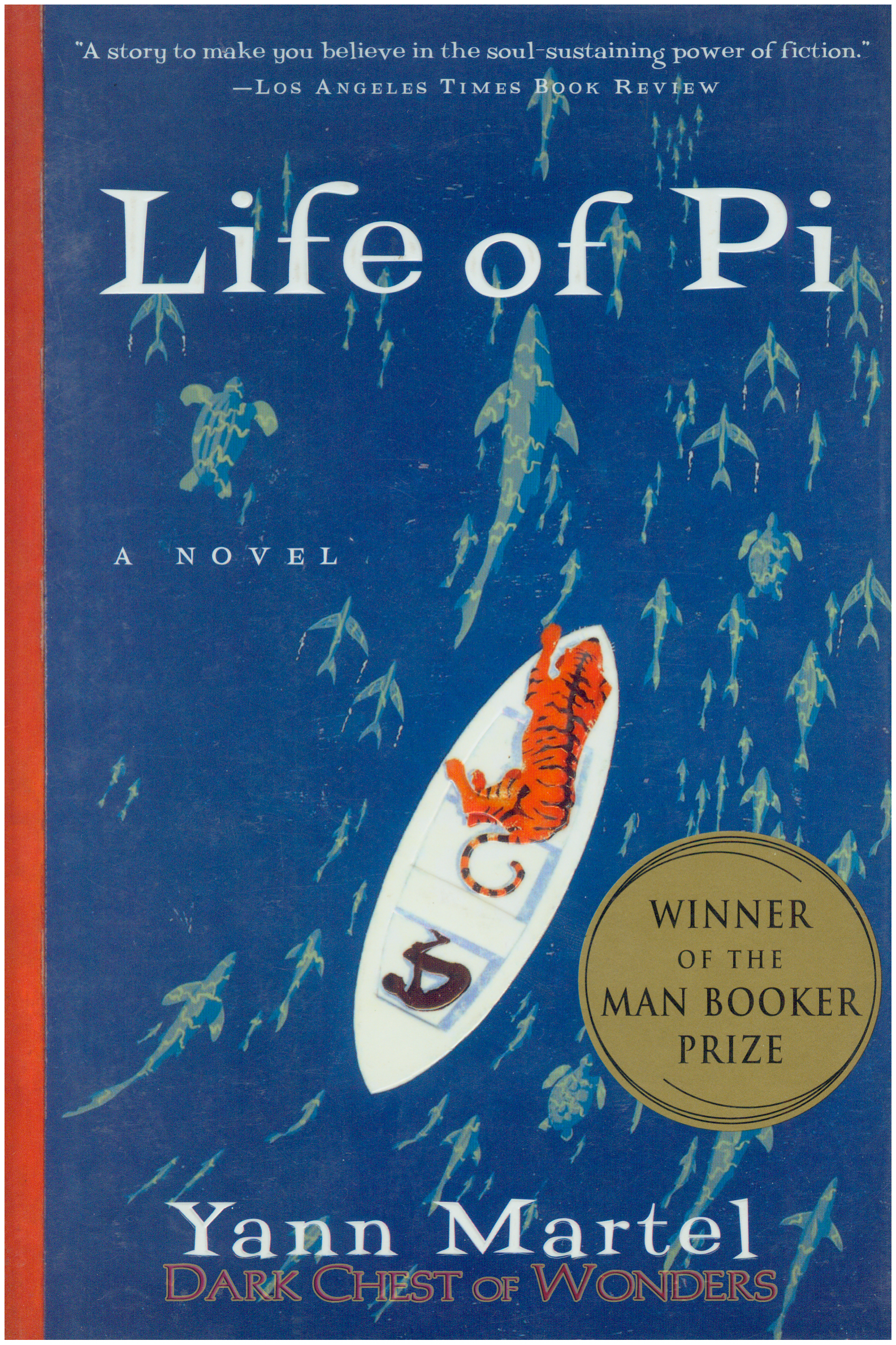
"Life of Pi" by Yann Martel (2001)
A story about why we tell stories and why we choose to believe what we believe.
There is a pretty good chance that you are not smart enough to do this book review justice, or at least not wise enough. This is more your wife's territory. Liz has both the wisdom and the spiritual intelligence to explore all of the richness this story deserves. You probably do not. Nevertheless, (and since she refused to write this review for you) here goes nothing.
"Life of Pi" is about a boy named Pi, but it is not the story of his life. It is only the story of his experience as a young boy growing up in a charming seaside town in India in a family that owned a zoo. But, more importantly, it is a story about his extraordinary transformation into an adult. At the age of sixteen, Pi survives a shipwreck and lives on a lifeboat in the Pacific for an incredible amount of time. He floats on the open ocean until he lands on a Mexican beach where the story promptly ends.
But that's not what the book is about.
There is a tiger, named Richard Parker, on the lifeboat with Pi. Somehow, this sixteen year old boy is able to keep himself alive and coexist with a 450 lb tiger for months and months on a 25 foot boat. The tiger provides the impetus for Pi to stay alive and to gather enough food and water to keep both of them alive. Without the tiger, Pi wouldn't have survived the ordeal, yet Richard Parker is a constant threat to Pi's very existence. Together, they witness unimaginable beauty and almost unbelievable wonders.
But that's not what the book is about.
As a boy, Pi (his real name is Piscene Patel, but he chose Pi as a nickname to avoid the humiliation of other children calling him "Pissing" Patel) is fascinated by religion. Raised a Hindu, he is soon captivated by the beauty and depth of both Christianity and Islam. In one scene, Pi's parents are confronted in their home by three wise men, a priest, an imam, and a pandit, all of whom demand to know why they are each equally convinced that Pi is their most devout student. Pi honestly sees the beauty and the Truth in all of these religions and embraces each of them equally. He revels in their story telling and their rich histories. He finds significance in his everyday life through relating everything back to some Hindu scripture, or some Muslim prayer, or some New Testament parable. Pi is much more concerned with the act of having faith than he is in the truth behind each Faith.
Now this... this might be what the book is about.
"Life of Pi" is beautifully written and wonderfully descriptive (sometimes quite graphic when the tiger is devouring some unfortunate animal or when Pi is gutting a turtle). The adventure on the high seas is addictive. Once you started on that part of the book, you really couldn't put it down. But it became very obvious by the end of the novel, that the story meant something else. Yann Martel was trying to reveal some deeper truth to you through the gift of allegory. But the great thing about story telling, about allegory, about books in general, is that it doesn't really matter what the author or story teller is trying to say. A book doesn't belong to the author. It belongs to the reader. So, whatever lessons Martel intended to teach you might be lost on you, other readers may glean deeper truths from it, and learn more profound messages, but that doesn't mean that the book didn't teach you anything at all.
This book is about stories. It explores why we tell one another stories as part of our interaction, why we tell ourselves stories as well. They are not needed. Life will continue without our telling one another new (and old) stories over and over again. Stories make life worth living, and sometimes the stories we craft in our own heads, the narrative constructs that we fabricate to justify our actions even to ourselves, are the only things that keep us going.
"Life of Pi" is also, undoubtedly, about faith. It is a book that openly explores the idea of God and approaches him from many angles, including atheism. In fact, Martel heaps the most scorn on agnostics. "Doubt is useful for a while," Pi tells us early on in the book. "If Christ played with doubt, so must we... surely we are permitted to doubt. But," he warns, "We must move on. To choose doubt as a philosophy of life is akin to choosing immobility as a means of transportation." And later, in a paragraph that constitutes an entire chapter Pi tells us,
Truth simply explains. Faith inspires.
At the very end, in the last pages of the story, Pi tells a second, alternative story of his voyage. One that isn't as wonderful or beautiful, but is more believable. He challenges you to choose which story you prefer. There must be people out there who choose the second, more depressing, less fantastic story to put their faith in. But not you.
You will take the boy and the tiger every time.
You never want to miss the better story.
On to the next book!
There is a pretty good chance that you are not smart enough to do this book review justice, or at least not wise enough. This is more your wife's territory. Liz has both the wisdom and the spiritual intelligence to explore all of the richness this story deserves. You probably do not. Nevertheless, (and since she refused to write this review for you) here goes nothing.
"Life of Pi" is about a boy named Pi, but it is not the story of his life. It is only the story of his experience as a young boy growing up in a charming seaside town in India in a family that owned a zoo. But, more importantly, it is a story about his extraordinary transformation into an adult. At the age of sixteen, Pi survives a shipwreck and lives on a lifeboat in the Pacific for an incredible amount of time. He floats on the open ocean until he lands on a Mexican beach where the story promptly ends.
But that's not what the book is about.
There is a tiger, named Richard Parker, on the lifeboat with Pi. Somehow, this sixteen year old boy is able to keep himself alive and coexist with a 450 lb tiger for months and months on a 25 foot boat. The tiger provides the impetus for Pi to stay alive and to gather enough food and water to keep both of them alive. Without the tiger, Pi wouldn't have survived the ordeal, yet Richard Parker is a constant threat to Pi's very existence. Together, they witness unimaginable beauty and almost unbelievable wonders.
But that's not what the book is about.
As a boy, Pi (his real name is Piscene Patel, but he chose Pi as a nickname to avoid the humiliation of other children calling him "Pissing" Patel) is fascinated by religion. Raised a Hindu, he is soon captivated by the beauty and depth of both Christianity and Islam. In one scene, Pi's parents are confronted in their home by three wise men, a priest, an imam, and a pandit, all of whom demand to know why they are each equally convinced that Pi is their most devout student. Pi honestly sees the beauty and the Truth in all of these religions and embraces each of them equally. He revels in their story telling and their rich histories. He finds significance in his everyday life through relating everything back to some Hindu scripture, or some Muslim prayer, or some New Testament parable. Pi is much more concerned with the act of having faith than he is in the truth behind each Faith.
Now this... this might be what the book is about.
"Life of Pi" is beautifully written and wonderfully descriptive (sometimes quite graphic when the tiger is devouring some unfortunate animal or when Pi is gutting a turtle). The adventure on the high seas is addictive. Once you started on that part of the book, you really couldn't put it down. But it became very obvious by the end of the novel, that the story meant something else. Yann Martel was trying to reveal some deeper truth to you through the gift of allegory. But the great thing about story telling, about allegory, about books in general, is that it doesn't really matter what the author or story teller is trying to say. A book doesn't belong to the author. It belongs to the reader. So, whatever lessons Martel intended to teach you might be lost on you, other readers may glean deeper truths from it, and learn more profound messages, but that doesn't mean that the book didn't teach you anything at all.
This book is about stories. It explores why we tell one another stories as part of our interaction, why we tell ourselves stories as well. They are not needed. Life will continue without our telling one another new (and old) stories over and over again. Stories make life worth living, and sometimes the stories we craft in our own heads, the narrative constructs that we fabricate to justify our actions even to ourselves, are the only things that keep us going.
"Life of Pi" is also, undoubtedly, about faith. It is a book that openly explores the idea of God and approaches him from many angles, including atheism. In fact, Martel heaps the most scorn on agnostics. "Doubt is useful for a while," Pi tells us early on in the book. "If Christ played with doubt, so must we... surely we are permitted to doubt. But," he warns, "We must move on. To choose doubt as a philosophy of life is akin to choosing immobility as a means of transportation." And later, in a paragraph that constitutes an entire chapter Pi tells us,
"I can imagine an atheist's last words: "White, white! L-L-Love! My God!" -- and the deathbed leap of faith. Whereas the agnostic, if he stays true to his reasonable self, if he stays beholden to dry, yeastless factuality, might try to explain the warm light bathing him by saying, "Possibly a f-f-failing oxygenation of the b-b-brain." and, to the very end, lack imagination and miss the better story."This is important because the story that unfolds after this is patently unbelievable. As wondrous as the story of the boy and the tiger on the boat is, as beautifully as it is told... it is unbelievable. But so what? Any good story deserves embellishment. Hell, you can't even talk about going to the grocery store without tossing in a few extra details! It doesn't matter anyway. There is power in truth, but what this book reminded you of is that there is more power in belief.
Truth simply explains. Faith inspires.
At the very end, in the last pages of the story, Pi tells a second, alternative story of his voyage. One that isn't as wonderful or beautiful, but is more believable. He challenges you to choose which story you prefer. There must be people out there who choose the second, more depressing, less fantastic story to put their faith in. But not you.
You will take the boy and the tiger every time.
You never want to miss the better story.
On to the next book!
Wednesday, April 10, 2013
"The House at Pooh Corner" by A. A. Milne (1928)
Yeah... Pooh Bear. Got a problem with it?
You decided to read a Winnie the Pooh book. You needed to read something completely opposite from the last book because Good Grief! That was depressing.
You had no idea that Winnie the Pooh was so old. A.A. Milne's first Pooh book came out 87 years ago! You thought Pooh had only been around since the 60's, probably because that's when Disney started making the cartoons. Stupid Disney, always corrupting the way you think about things. While the classic characters are quite a bit different from the Disney creations (Eeyore is a lot more sarcastic than you'd expected) they maintained their basic traits. Pooh is always sweet and daft and hungry, Piglet is worried and fearful and constantly seeking approval, Rabbit is always bossy and controlling, Tigger is perpetually bouncy and quixotic, Kanga is a perfect mother, and Roo the perfect little son. These characters were familiar and comforting, and just the thing you needed after the last book's wrenching imagery.
The book itself, the physical book, was charming as well. The small hardback was only slightly larger than your open palm with a little pooh Bear silhouette embossed into the soothingly light blue cover. The edge of each page was lined with silver, so that when the book was open you couldn't see anything remarkable, but when it was closed it appeared to be a block of precious metal nestled in a hard back cover. This silver lining caught the light every time you turned a page so that it seemed like there was a shimmering archway leading you to each new page. Ebooks are great and encourage people to read more, and nothing will ever supplant their extraordinary portability and ease of access, but there really is something about holding a good, solid, dead-tree book in your hand.
You wanted to write this review and talk about each of the characters in these short stories. You wanted to examine the idea that each animal represents a different personality type, and how sometimes people can reflect more than one of these stereotypes. You wanted to focus on how loving Christopher Robin is to all of his friends, and how we are all equally worthy of love, regardless of how we interact with the world. You wanted to highlight some of the simple yet insightful language, to extensively quote some of the more quietly profound moments that struck you as wise and valuable for children to remember as they grow up.
But that's not what you wanted to remember about this book when you were done reading it. What you wanted to remember was the last chapter, maybe really only the last two or three pages.
A.A. Milne wrote many Winnie the Pooh stories and poems. They mostly only involve the animals in the Hundred Acre Woods and their interactions. Occasionally, Christopher Robin shows up to provide advice, encouragement, and moral support. Christopher Robin is clearly an homage to Milne's own son, Christopher Robin Milne. These stories were written as Milne's way of capturing his son's childish imagination for posterity, so that his love for his stuffed animals would never be forgotten. In the last chapter of "The House at Pooh Corner," it becomes clear to all the animals that Christopher Robin is leaving them. They don't know where he is going, but you knew that this meant that he was growing up... as little boys do.
Eeyore writes Christopher Robin a poem saying goodbye and all of the animals sign it as best they can. They all deliver the poem to him but as he reads it, the animals all fade away back into the wood. When the boy finishes reading and lifts his head only Pooh Bear is left.
His beloved silly old Bear.
As the last few silver lined pages unfolded before you, Christopher Robin and Pooh Bear get up and go on one last walk through the woods together. They talk as they always have, as friends who understand one another more deeply than even they themselves realize. Christopher Robin admits to Pooh that what he loves more than anything else in the world is doing Nothing. "How do you do Nothing?" Pooh wonders aloud.
"Well," says Christopher Robin," it's when people call out at you just as you're going off to do it, What are you going off to do, Christopher Robin, and you say, Oh, nothing, and then you go and do it." "Oh, I see," Pooh says.
Soon the two arrive at an enchanted spot on a hilltop, surrounded by trees. And for the first time in their lives together, Christopher Robin begins telling Pooh Bear about the real world; about Kings and Knights, about factories and a place called Europe. Pooh Bear, enchanted and confused (as always) asks if a Bear could be a Knight. So right there in that enchanted spot on a hill in the Hundred Acre Woods, Christopher Robin makes a Knight of his best friend.
Suddenly, chin in hands and eyes on the world spread out at the foot of the hill, Christopher Robin admits to Pooh that,
"I'm not going to do nothing anymore.""Never again?""Well, not so much. They don't let you."
At this, Pooh promises to always be there for his closest and dearest friend, and that he will never forget Christopher Robin.
"Pooh, said Christopher Robin earnestly, "If I - if I'm not quite -- " he stopped and tried again -- "Pooh, whatever happens, you will understand, won't you?""Understand what?""Oh, nothing." He laughed and jumped to his feet. "Come on!""Where?" said pooh.""Anywhere," said Christopher Robin.
And then this last paragraph got you.
"So they went off together. But wherever they go, and whatever happens to them on the way, in that enchanted place on the top of the Forest, a little boy and his Bear will always be playing."
That place isn't on a hill in a Forest, it's in A. A. Milne's heart. It's in the heart of every good parent. It's that part of us all, that part of you that wants your children to grow up, but realizes how deeply you will miss them when they do, how deeply you already miss their younger selves. As a father of young boys, people are always reminding you that these wonderful moments of childhood imagination and joy are so fleeting, they want to tell you to hold on to them and remember them.
Nicholas with his imaginary T-Rex friend, Kranken, or his invisible mouse protector, Canby. Lincoln with his stuffed Woody doll from Toy Story; every child is Christopher Robin at some point in their lives. And every parent is A.A. Milne. "The house at Pooh Corner" was one father's way of cherishing his son's childhood, and it was a reminder to you to not let your boys' childhoods slip away without taking the time to notice the little things, to treasure them, and to do what you can to remember them. They won't last long.
On to the next book!
Subscribe to:
Posts (Atom)